

This digital guide is a practical resource to help electric cooperatives address the unique challenges of integrating large loads. Based on candid interviews, market research and analysis, this guide shows how cooperatives are earning new business and delivering value to their communities—while adopting robust contract structures to protect members from bearing the costs of serving large loads.
knowledge exchange
Earning the business by demonstrating network value
Key points
- UEC strives to earn its data center business by demonstrating measurable network value that delivers cost certainty, timely connection, and long-term benefits for the new member and the broader community.
- By using “not to exceed” cost estimates, the cooperative is able to break projects into smaller packages, requiring upfront payments for major equipment and managing procurement and contractor relationship to ensure cost certainty and protect legacy members.
- The rise of data centers now accounts for 80%-85% of UEC’s load, prompting a transformation from a hometown service culture to a strategic enterprise with new staff roles and operational approaches.
The Pacific Northwest's data center surge was driven by robust fiber optic connections to trans-Pacific cables, favorable tax incentives, low-cost electricity, and key utility partnerships. We interviewed Robert Echenrode, CEO of Umatilla Electric Cooperative in Oregon (UEC), to gain a better perspective of the buildout in this region and his co-op’s experience in serving data centers.
Construction on UEC’s first data center began back in 2008 but the unfinished project stalled about a year in with the Great Recession and the ensuing industry downturn. By 2012, development recommenced with two additional locations being constructed in parallel with the original site. The new projects, however, were significantly more ambitious, reflecting the industry’s evolution from single-building sites to more expansive, multi-building campuses. To accommodate the increased load density, existing substations had to be expanded, with the customer taking the lead by retaining their contractor for the construction needed. It was at this time that Robert began his work at UEC, initially heading engineering in 2013 and later as the co-op’s CEO in 2016. His initial goal was to reintegrate the distribution system construction, enhancing oversight of these big projects while minimizing member expense and cooperative risk.
Do large loads often build their own infrastructure? And should utilities be concerned that data centers might bypass local distribution system investment with DIY solutions? Media reports imply that this is the contemporary challenge facing utilities—with a familiar ring to those earlier debates about the utility death spiral related to distributed generation. A recent Wall Street Journal article, AI Data Centers, Desperate for Electricity, Are Building Their Own Power Plants, forewarns major tech companies are now in the business of building power plants to address infrastructure delays. Or, as the article puts it, mega-electricity consumers are proactively seeking solutions instead of waiting around for the archaic U.S. power grid to catch up.
The cooperative’s role is to facilitate—not hinder—economic growth, and data centers can bring substantial benefits if the relationship is managed with openness and integrity.
Yet, EIA data shows electricity-intensive customers have regularly built their own power systems, with direct or onsite generation accounting for approximately 12% of the nation's industrial electricity demand. This evolving cycle of data center-led development just perpetuates that trend, with these large consumers building their own downstream distribution substations and working upstream to connect utility-scale generation. Still, collaborative utility partnerships can be powerful, enabling the sort of redundancy essential for maintaining uptime and reliability, which are core requirements for data center operations. And when the relationship is managed with openness and integrity, even greater agility can be achieved through co-op and member collaboration.
Speed-to-connection is often the compelling driver for data centers’ go-it-alone approach but that can leave substantial, hard-to-replicate, network value on the table. UEC had to validate the cooperative model to both reclaim the process and earn its member’s confidence. The co-op needed to demonstrate technical expertise and produce measurable savings, ensuring the facility was energized on schedule and within budget. Process agility became a key factor. UEC leveraged three large mobile substations, which could be utilized to connect new facilities quickly, using existing transmission lines or short taps. And importantly, by integrating with the co-op’s distribution system, the data center’s long-term transmission investments now benefit the broader community.
Building an “open for business” co-op approach
As a result of the community’s interest in attracting data centers and UEC’s commitment to enabling that desire, the co-op’s load has grown, and the composition has shifted dramatically over the past decade. Data centers now account for approximately 80-85% of the load, changing the traditional balance among residential, agricultural, and commercial customers.
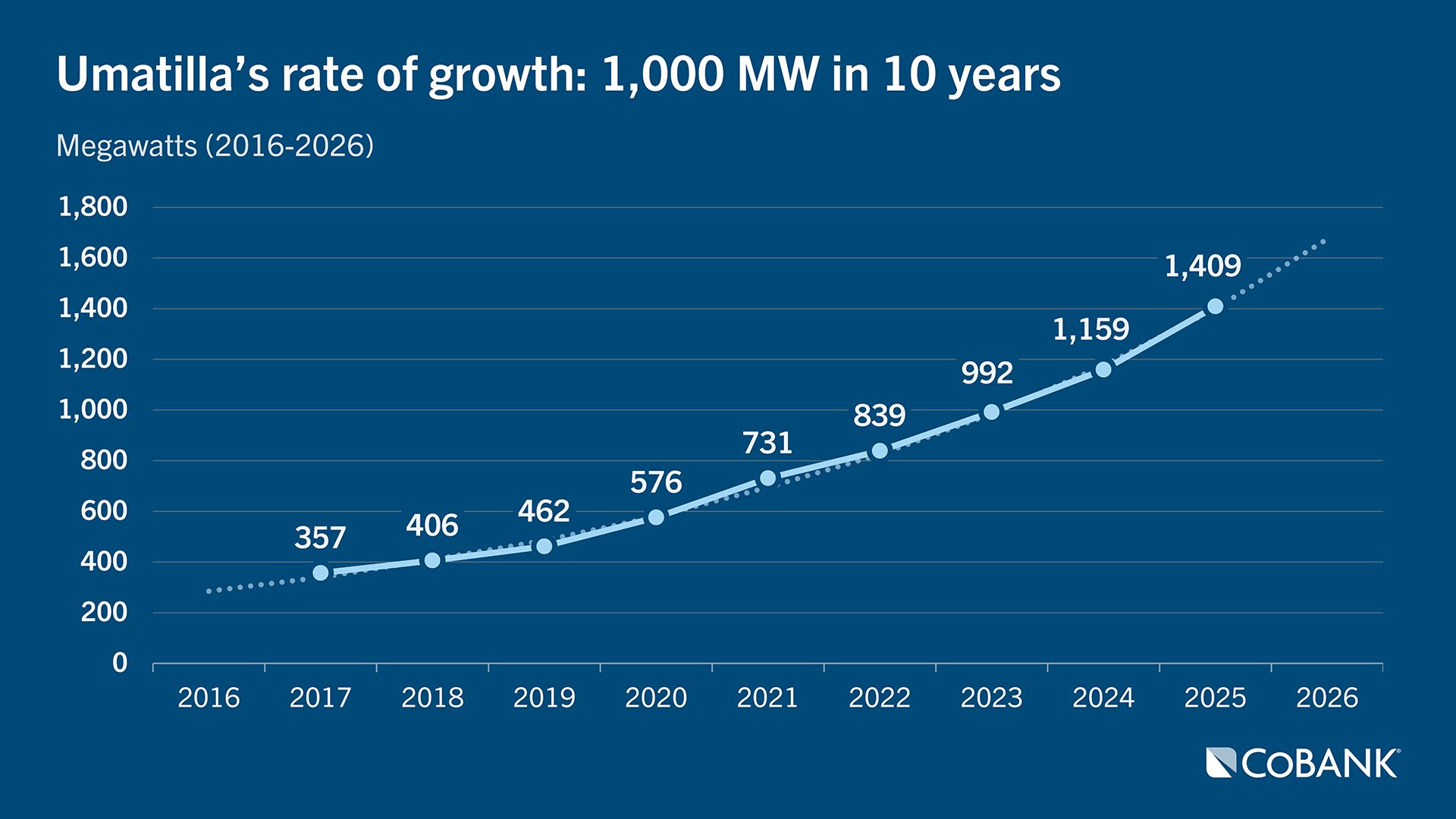
Without a doubt, the integration of these large data center loads has brought about a cultural shift within UEC, demanding flexibility and adaptation from staff and leadership. Robert discussed the challenges of changing mindsets and processes to accommodate the fast-paced needs of data centers. The changing load composition transformed the co-op from what was perceived as a “hometown service culture” to a “strategically-focused enterprise,” offering employees new and challenging opportunities to grow and develop within the electric cooperative space, while also restructuring to support the new operational approach.
In a conversation with NRECA’s Pat Mangan, the host of Governance Talk, Robert noted that UEC was formerly a member of a generation and transmission cooperative with an all-requirements power supply contract. Under that contract, absorbing a single data center might have been manageable but the multiplier effect of exponential growth changed the risk on the cooperative, the G&T, and the other G&T members. UEC’s solution was to separate from its G&T and source power supply directly from the wholesale market through firm transmission.
The challenge was that distribution cooperatives seldom have the skill sets to enter the wholesale power supply market. UEC’s approach was to identify and retain industry experts who helped guide their processes and establish safeguard procedures to protect their membership. Eventually, they transitioned into hiring internal staff and now have three full-time employees devoted to power supply and transmission services.
UEC established a retail rate for large loads that passes through market and transmission costs, including penalties and returning credits, directly to the member. This rate design ensures cost accountability where it is incurred, while protecting legacy members from exposure to market volatility associated with pooled power supply obligations. By aligning cost responsibility with usage, UEC preserved system equity, maintained rate stability for existing members, and provided a scalable framework for future large-load interconnections.
Achieving marginal cost pricing through rate design
UEC serves data centers under its Schedule 6 Large Industrial Rate, which is applicable for any member with an expected or historical measured Maximum kW Demand of more than 10,000 kW or identified as a New Large Single Load (NLSL) by Bonneville Power Administration (BPA). The alignment with BPA’s large load policy is important here. BPA’s long-established policy was meant to ensure that large loads would pay for the marginal cost of new power supply to avoid preferential relocation and cost-shifting to legacy customers.
When Congress passed the 1980 Pacific Northwest Electric Power Planning and Conservation Act, also known as the Northwest Power Act, it directed that customers requesting power from the federal system to serve large loads be served at BPA’s marginal resource cost-based rate. This rate treatment is intended to limit the relocation of large loads from other parts of the country to the Pacific Northwest that otherwise would be attracted by low-cost federal power.
During a previous period of significant large load growth in the country, the lion’s share of the aluminum industry was established in the Pacific Northwest region. In fact, the completion of the first transmission line from Bonneville Dam to Vancouver in 1939 marked the beginning of the Northwest aluminum industry. Aluminum smelting in the region started during the early 1940s to help build up for the war effort and to provide a market for hydroelectric power production in the region. Smelting capacity was expanded throughout the 1960s and 1970s. At its zenith, the region’s smelters—BPA’s direct service industries (DSIs)—accounted for 40% of the U.S. aluminum smelting capacity and about 6% to 7% of the world’s capacity. Around 1980 the cost and availability of electricity supplies to the Pacific Northwest aluminum plants began to change dramatically. At the time, BPA supplied all the smelters’ electricity needs at very competitive prices. However, between 1979 and 1984 Bonneville’s electricity prices increased by nearly 500%.
Aluminum smelters in the Northwest were among the first large-load electricity customers. They paid the marginal cost of new power, avoiding cost-shifting to legacy customers.
The fact that legacy electricity consumers, including aluminum smelters, had no preferential access to the federal hydroelectric energy meant that their electricity supplies were threatened. The Northwest Power Act extended access to aluminum smelters in exchange for these large loads covering the cost of service for residential and small commercial consumers for a time. Other requirements evolved such as interruptible provisions and gradual ratcheting down of preferential allocations, leading to greater power supply exposure to the marginal cost of acquiring new resources for the region. BPA’s latest fact sheet lists its wholesale power rates for fiscal year 2022-2023 as 3.49 cents/kWh for priority legacy customers and 7.88 cents/kWh for new sources.
UEC’s Large Industrial Rate consists of two main parts: the Energy and Transmission Services Charge for upstream wholesale power, and the Delivery Charge for downstream distribution costs. The Energy and Transmission Services Charge will pass through to members all charges and costs reasonably incurred to acquire wholesale power, reflecting the marginal cost structure of this region. These are the costs UEC incurs to acquire wholesale power, transmission and related services necessary to serve the amount of energy required by the member’s facility. If the member’s forecast requirements are greater or lesser than the actual scheduled load, UEC will also pass through the associated losses or credits to acquire or dispose of surplus wholesale power.
The UEC Delivery Charge is a flat $1.24 per kVA for the base nameplate rating of the electrical transformer(s) used by UEC to provide electric service to the member’s facility. The charge is calculated taking into consideration UEC’s costs to serve the account, including but not limited to overhead costs, capital costs, operations and maintenance costs, margin contribution and demand-related costs.
UEC’s Large Industrial Rate consists of two main parts: the Energy and Transmission Services Charge for upstream wholesale power, and the Delivery Charge for downstream distribution costs.
A catch-all category of charges, UEC calls Other Charges and Credits, reflects other expenses incurred by UEC on behalf of the member, not otherwise recovered in the Energy and Transmission Services Charge or the Delivery Charge. Additional payment requirements are also specified for operational costs incurred by UEC for member-caused system anomalies (>Reactive Power Factor Charge and Harmonics Power Quality Charge).
Key service terms include a member requirement to provide a reasonable and good faith load estimate for the first three years of electric service that is updated on a quarterly basis after facility energization. Installing or operating generation facilities connected to UEC needs advanced written consent. Back-up generators must run only occasionally, safeguard the UEC system and be reported to UEC in advance or within 24 hours.
UEC’s approach demonstrates how a cooperative can successfully serve large, electricity-intensive customers like data centers by combining technical competence, financial discipline, disciplined rate design and strategic use of grid resources. The result is a sustainable model that supports economic growth, protects legacy members and adapts to the evolving demands of the digital economy.
Disclaimer: The information provided in this report is not intended to be investment, tax, or legal advice and should not be relied upon by recipients for such purposes. The information contained in this report has been compiled from what CoBank regards as reliable sources. However, CoBank does not make any representation or warranty regarding the content, and disclaims any responsibility for the information, materials, third-party opinions, and data included in this report. In no event will CoBank be liable for any decision made or actions taken by any person or persons relying on the information contained in this report.